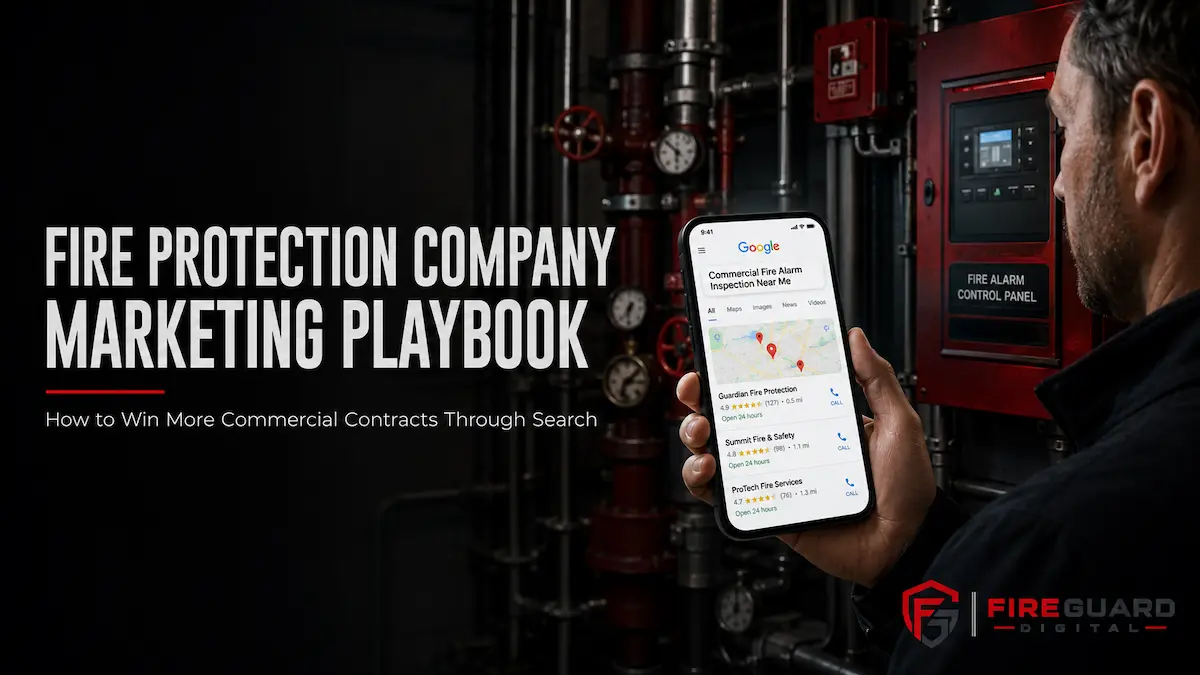
The Fire Protection Company Marketing Playbook
Right now, a facility manager in your area has a problem. An inspection is due. A deficiency report came back. A fire alarm is faulting. Or a compliance deadline is closing in.
So they do what everyone does. They search.
They look for a local company that appears credible, offers the exact service they need, and is easy to contact. Then they call one of the companies that shows up first.
If your company is not visible in that moment, you do not lose a lead in your inbox. You lose an opportunity you never knew existed.
That invisibility costs inspections, deficiency repairs, recurring service agreements, and long-term commercial accounts.
This is not a guide about posting more often on social media or chasing random leads. It is a commercial-first playbook for showing up when facility managers, property managers, contractors, and building owners are actively looking for fire protection help.
I am an active firefighter, and I have also spent the last decade working in SEO and Google Ads. Those worlds rarely overlap. But together, they have made one problem very clear: many fire protection companies do excellent work in the field while remaining almost invisible where commercial buyers now look first.
I built FireGuard Digital exclusively for fire protection companies because this trade has different buyers, different service lines, and different search moments than most local businesses.
Everything in this guide is built around how commercial fire protection work is actually found, evaluated, and won.
Inside, you will learn how to build a search presence that helps you win the right opportunities: the inspections, repairs, testing agreements, and recurring accounts that create real long-term value.
Read it from start to finish or jump to the section that matters most right now. Either way, you will leave with a clearer plan for becoming easier to find when the right commercial opportunity appears.
Table of Contents
Why Fire Protection Marketing Is Different (and Why Generalists Fail)
Fire protection is not a generic local service.
It is commercial, compliance-driven, service-specific, local, urgent, and built on trust. That changes how your marketing needs to work.
Your buyers are facility managers, property managers, contractors, and building owners. They are not casual shoppers. They are commercial decision-makers with inspection deadlines, deficiencies, repairs, documentation requirements, and risk on the line.
When they search, they are usually looking for a specific service and a company they can trust to handle it properly.
That is where many generalist agencies get it wrong.
They treat fire protection like plumbing, HVAC, or another broad local-service category. They chase traffic and raw lead volume. They target broad keywords, write generic posts about “fire safety awareness,” and run Google Ads that bring in homeowner questions instead of commercial opportunities.
They often cannot tell the difference between a facility manager searching for a commercial fire alarm inspection and a homeowner looking for help with a smoke detector.
The result is predictable. You pay for marketing and get random calls, residential price-shoppers, irrelevant traffic, or no meaningful opportunities at all. Then it feels like digital marketing does not work for fire protection companies.
Digital works. The approach was wrong.
Fire protection companies do not need more leads at any cost. They need to appear at the exact moments commercial buyers are searching for inspection, testing, maintenance, deficiency work, monitoring, and compliance support.
That is a different goal, and it requires a different system.
The U.S. fire protection industry alone is worth roughly $22.1 billion, with nearly 20,000 contractors serving the market. Yet many of those companies have done very little to build a serious presence in commercial search.
That creates an opportunity.
The companies that build around how commercial buyers actually search can become easier to find, easier to trust, and harder to replace in the markets they serve.
What Search Invisibility Is Costing You Right Now
Most fire protection companies are not losing business because they do poor work. They are losing it by being invisible in search at the moment a commercial buyer needs help.
A facility manager searches for an inspection, repair, deficiency issue, or compliance service. A competitor appears first, looks credible, and is easy to contact. They get the call.
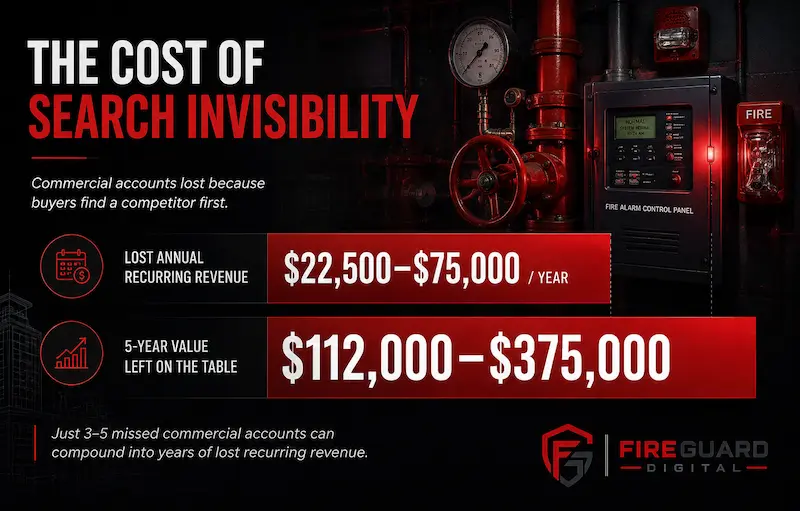
That can quietly cost a fire protection company five to ten commercial accounts a year.
At $4,500 to $7,500 per account each year, that is $22,500 to $75,000 in annual recurring revenue going to competitors simply because they were easier to find.
Here is the math.
One commercial inspection account is worth $4,500 to $7,500 a year. That includes the inspection work itself, along with the deficiency repairs and follow-up service that often come with it.
Most of those accounts renew. Switching vendors is a hassle for a facility manager, especially when a company already understands the building, the systems, and the service history. Once you win the account, you tend to keep it.
Over five years, with renewals, it adds up to $112,000 to $375,000 in accounts you never knew were available.
That makes each new commercial client worth far more than a single job. It also changes how much you can spend to win one.
Note: These figures are based on publicly listed pricing across many regions. Your actual numbers will vary by area and by the services you deliver.
This is why the goal is not simply more leads.
A random call wastes your team’s time. A qualified commercial opportunity can become an inspection, a deficiency repair, a recurring testing agreement, a monitoring account, or a long-term relationship. That is the work worth being found for.
It also helps to understand how commercial buyers make decisions. Most B2B buyers are about 70% of the way through their decision before they ever contact a vendor, and most begin with a search.
A recent Gartner survey found 61% of B2B buyers prefer to buy with no sales rep involved until late in the process. If your company is not visible while they research, you are not on the list when they finally reach out.
That does not mean referrals are broken. Referrals are valuable. They are simply passive. They only capture demand you are already connected to.
Search captures the demand you never knew existed.
And when a major account leaves, referrals alone leave nothing to absorb the hit. The rest of this playbook shows you how to build a search presence that can.
The FireGuard Search Stack: A Commercial-First Marketing System
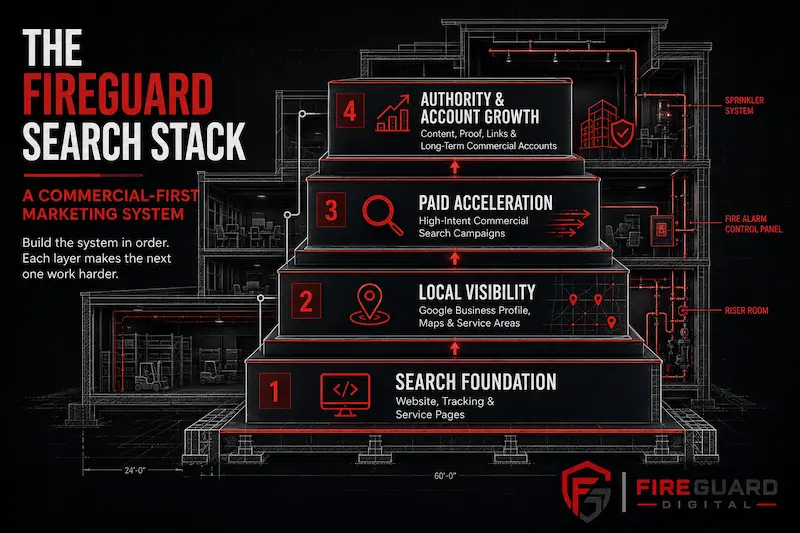
Most agencies sell SEO, Google Ads, websites, and Google Business Profile work as separate services.
But commercial buyers do not experience search that way.
When a facility manager looks for fire protection help, they may see Google Ads, map listings, reviews, organic results, service pages, competitors, and AI-generated answers within the same search journey.
They are not thinking about channels. They are deciding which company looks credible, relevant, and easy to contact.
That is why disconnected marketing tactics often create activity without creating account growth.
A company might run ads without strong landing pages. It might publish content without building local visibility. It might optimize a Google Business Profile without tracking which calls become real commercial opportunities. Each tactic can look busy on its own. But without a connected system, the work does not build on itself.
The FireGuard Search Stack connects those pieces together into one commercial-first marketing system. It is built around how fire protection buyers actually search, compare, and choose.
The system has four layers, and they need to be built in order.
Layer One: Search Foundation.
Your website, tracking, service pages, and Google Business Profile need to be strong enough to support growth before you scale anything else. This is the base layer. Without it, more traffic simply reaches pages that are unclear, hard to trust, or difficult to contact.
Layer Two: Local Visibility.
Next, your company needs to show up in the cities and service areas where commercial buyers are searching. That means stronger visibility in the map pack, local results, and the service-specific searches that matter in your market.
Layer Three: Paid Acceleration.
Google Ads can then capture high-intent commercial searches faster while your organic visibility builds. The focus is not on generating the most clicks. It is on appearing for the high-value searches that signal a real need for inspection, testing, repair, deficiency work, or compliance support.
Layer Four: Authority & Account Growth.
The final layer builds long-term trust and makes your visibility harder to replace. Content, links, mentions, proof, and reporting help position your company as the credible choice while showing which marketing activity is actually leading to recurring commercial accounts.
Build them in order.
Running ads before the foundation is ready can send expensive clicks to pages that do not convert. Building local visibility without clear service pages leaves buyers with nowhere useful to land. Publishing content without proof or tracking makes it difficult to turn attention into measurable account growth.
Each layer makes the next one work harder. That is how search becomes a system for winning commercial accounts instead of a collection of disconnected marketing tactics.
How to Market a Fire Protection Company: The 6-Step Playbook
The FireGuard Search Stack is the larger system. This six-step playbook shows you how to put it into action.
Each step closes a different gap between doing great work in the field and being found by the commercial buyers who need it. Some steps help you become easier to find. Others help you turn that visibility into qualified opportunities, recurring service work, and long-term accounts.
The goal is not to do everything at once. It is to build the right pieces in the right order, so each part supports the next.
Here is the six-step playbook:
- Build a website and service pages strong enough to support search growth.
- Claim and optimize your Google Business Profile.
- Get found for the service searches commercial buyers actually use.
- Run tightly managed Google Ads on high-intent commercial keywords only.
- Build authority with proof and content that turns visibility into accounts.
- Track every call and form back to the qualified opportunity it produced.
Work through these steps in sequence. You do not need a complicated marketing machine. You need a clear system that makes it easier for the right commercial buyers to find you, trust you, and contact you when they are ready to act.
Step 1: Build Your Search Foundation
Your search foundation is what makes every other marketing effort work.
If your website is thin, your service pages are missing, or your tracking is broken, SEO and Google Ads will both underperform. More traffic will not solve the problem. It will just send more people to a site that does not clearly explain what you do or make it easy to contact you.
Start with dedicated pages for the commercial services you actually want to win.
That may include fire alarm inspection, sprinkler ITM, fire extinguisher service, kitchen suppression, fire pump testing, backflow, deficiency repair, and any other core services you provide.
Start with dedicated service pages. One page each for fire alarm inspection, sprinkler ITM, fire extinguisher service, kitchen suppression, fire pump testing, backflow, deficiency repair, and any other service you offer.
A facility manager searching for “fire alarm inspection” should land on a page about fire alarm inspection. They should not have to sort through a generic Services page that lists fifteen offerings in a few short sentences.
Each service page should clearly explain the work, who it is for, the types of buildings or systems you support, the areas you serve, and how to request service or a quote.
A generic services page can still have a place on your site, but it is rarely enough on its own.
Then focus on the basics that determine whether a busy commercial buyer reaches out.
Your phone number and a clear call to action should be visible without scrolling. The site should load quickly on mobile, because many facility managers will check options from their phone. Use real photos of your team, trucks, inspections, and commercial jobs wherever possible. Add reviews from commercial clients near the top of key pages, where they can build trust quickly.
Build the site with SEO friendly structure in place from the beginning. A website can look polished and still be difficult for Google to understand. It is much more expensive to launch a site first, then pay to restructure its pages, URLs, navigation, and content later for search performance.
Finally, set up tracking from day one.
Use call tracking, form tracking, and clear conversion paths so you can see what is producing real opportunities. Most companies skip this step and end up guessing which pages, campaigns, or services are worth investing in.
A strong foundation gives every later step somewhere productive to send traffic. It makes it easier for the right commercial buyers to understand your services, trust your company, and take the next step.
Want to see where your foundation stands right now? Get our free fire protection marketing audit. No pitch, just a clear look at what is helping you and what is holding you back.
Step 2: Build Local Visibility
Fire protection is local and regional.
You might serve several cities, but if Google does not clearly understand your service coverage, you will not show up where buyers search. Local Visibility connects your services to the markets you want to win.
That is what local visibility is about: connecting your services to the cities, regions, and commercial markets you serve.
A facility manager usually searches with a service and a place, like “commercial fire inspection [city]” or “fire sprinkler inspection near me.” Google answers with the map pack and a short list of local results.
Your job is to be on that list when the right buyer searches.
Start with your Google Business Profile. Claim it and complete every section, and make sure the information reflects the commercial work you want to win.
Add your full business info. Write a clear description of what you do and where. Choose the correct categories. Add each core service with a detailed description. Use real photos of your team, vehicles, inspections, and commercial projects so buyers can see that you work in their world.
The biggest decision in there is the primary category. Get that one wrong and you compete in the wrong group, and nothing else on the profile fixes it. The complete GBP guide for fire protection walks through all seven steps, including which categories to pick and the five mistakes that get profiles suspended.
Then build a simple system for collecting reviews from commercial clients.
Many fire protection companies have mostly residential reviews because homeowners are more likely to leave one without being asked. But a few detailed reviews from facility managers, property managers, or known commercial buildings can be far more valuable than dozens of homeowner reviews.
They help buyers trust that you handle the type of work they need. They also give Google stronger signals about the services and markets your company serves.
Consistency matters too. Keep your business name, address, and phone number identical everywhere they appear online. Small differences between listings can confuse Google and weaken your local trust and visibility.
Finally, build real service-area pages for the markets you want to target.
Do not simply copy your homepage and swap in a city name. Each page should speak to that specific market. Reference the types of buildings you commonly serve, the local authority having jurisdiction (AHJ), regional code considerations, and the service needs commercial buyers in that area are likely to have.
Strong local visibility makes it easier for Google to understand your company, and easier for the right commercial buyers to find you when they need help.
Step 3: Get Found for the Searches That Matter (SEO)
SEO can work extremely well for fire protection companies. But it needs to target the searches commercial buyers actually use when they need help.
That means specific searches such as “NFPA 25 inspection requirements,” “commercial sprinkler testing,” “kitchen suppression inspection,” and “fire alarm deficiency repair.”
Generic “fire safety” content does not bring in commercial accounts. Yet that is what most companies and their agencies waste time on.
Commercial buyers search with precision.
They look for specific services, codes, systems, building types, and locations. Your website needs to answer those searches with the same level of precision.
A page on “fire suppression for data centers” that covers clean agents and pre-action systems will beat a vague “commercial fire suppression” page every time. It answers the exact question a real buyer is asking.
This is where commercial intent separates valuable opportunities from noise.
Commercial-intent searches usually signal that someone is close to taking action. They include terms such as inspection, testing, repair, contractor, compliance, deficiency, plus a location.
Searches like “how does a sprinkler work” or “smoke detector battery” are different. They may be useful informational topics, but they are less likely to lead to the type of commercial service work you want to win.
Focus your SEO efforts on the first group. Build pages that match the needs your ideal buyers are actively searching for. Filter out the residential and low-intent traffic that does not fit your business.
This step is the short version.
SEO for a fire protection company runs across three things: your website, your Google Business Profile, and what other credible sites say about you. The order you build them in decides whether any of it works.
That is a guide of its own, and we published it. It covers how to do SEO for a fire protection company in seven steps, including the Commercial Intent Filter, a four-question test for deciding which searches deserve a page.
Use this playbook for the whole marketing picture. Use that guide when you are ready to build the search side properly.
Remember, buyers do most of their research before they call. The more of their real service questions you answer, the more likely you are to be the company they reach out to. And the more likely they already trust you when they do.
Step 4: Accelerate With Google Ads
Google Ads is not a lead switch. It is an accelerant.
Used right, it captures the highest-intent commercial searches faster, while your SEO builds visibility over time.
You do not need to choose between fast results and long-term growth. Google Ads can provide speed, while SEO creates a more durable source of opportunity.
The key is focus.
Build campaigns around specific services and commercial buying intent. Do not run one broad campaign for every type of fire protection work you offer.
Instead, bid on searches that signal a real need, such as “commercial fire sprinkler inspection,” “fire alarm contractor near me,” or “emergency fire alarm repair,” paired with the cities and service areas you want to win.
Then protect your budget with negative keywords.
Block the searches that are unlikely to become commercial opportunities: homeowner questions, residential systems, DIY searches, training searches, job seekers, and people who are only doing early research. Every irrelevant click takes budget away from buyers who may actually need service.
Your landing pages matter just as much as your targeting.
Someone searching for fire alarm monitoring should land on a page about fire alarm monitoring. The page should quickly explain the service, the commercial systems or buildings you support, your coverage area, and how to request a quote or speak with your team.
Do not send every ad click to your homepage and make a busy facility manager search for the information they need.
Start with a smaller controlled budget while you learn which services, locations, and search terms bring in the right opportunities. Then measure the number that matters: cost per qualified commercial opportunity, not cost per click.
A cheap click that never becomes a conversation is not a win. A higher-cost click that leads to a $6,000 account that renews for years can be a very strong investment.
Feed lead quality back into the campaigns. As you learn which services and searches produce real inspections, repairs, monitoring accounts, and recurring service work, move more budget toward them.
That is how Google Ads becomes a focused system for winning commercial accounts instead of a source of random leads.
Step 5: Build Authority & Account Growth
A fire protection company cannot rely on a homepage and a few thin service pages forever.
Long-term growth needs authority: proof, depth, and trust across the searches commercial buyers use while they research, compare options, and decide who to contact.
This is the layer that turns visibility into real commercial accounts.
Start by building content around the questions facility managers and property managers are already asking.
For example:
- Does my sprinkler system still meet current NFPA 13, or was it grandfathered under an older code?
- When does a clean agent system make more sense than water?
- How do I handle a conflict between what the AHJ wants and what my insurer requires?
Each useful answer positions you as the expert and gives a potential buyer a reason to trust your company before they ever call. It shows that you understand the systems, compliance questions, and real-world decisions they are dealing with.
Then add proof.
Case studies, project examples, before-and-after deficiency repairs, and service-specific reviews all help show that your company does this work every day. A strong service page explains what you offer. Proof helps a buyer believe you are the right company to deliver it.
Authority also extends beyond your own website.
Google pays attention to what other credible sources say about your business. Relevant backlinks and mentions from industry associations, suppliers, local business groups, and trade publications strengthen your visibility and make your company harder for competitors to displace.
This same work also helps you appear in AI search.
About 32% of B2B buyers now use AI chatbots like ChatGPT and Google’s AI Overview to find vendors. That puts AI close to traditional web search and word of mouth as part of the buying process.
AI systems are more likely to reference content that is clear, factual, useful, and connected to a credible, identifiable business. A fire protection company that publishes specific answers, demonstrates real experience, and clearly explains what it does gives those systems more reason to surface its content.
Authority compounds over time.
A useful library of service pages, buyer questions, project proof, reviews, and industry mentions can keep producing value for years. An ad stops producing the moment you stop paying.
Start with the questions your team hears most often from commercial clients. Then build from there.
Step 6: Measure What Actually Closes
Marketing you cannot measure is marketing you cannot improve.
Tracking is what turns the FireGuard Search Stack from a collection of marketing activity into a system you can manage. It is also one of the most commonly skipped steps.
Start by tracking every meaningful contact point.
Use call tracking so you can see which page, campaign, or search term produced each phone call. Tag your contact forms by source, so you know whether an inquiry came from Google Ads, organic search, your Google Business Profile, a referral, or another channel.
Then take it one step further.
When a deal closes, trace it back to the search, ad, page, or referral source that first brought the opportunity in. Without that connection, you are left guessing. You may keep investing in campaigns that generate activity while overlooking the ones that actually produce commercial accounts.
Lead quality matters just as much as lead volume.
Talk to the people answering your phone. Find out which calls are real commercial opportunities, which ones are residential price-shoppers, and which ones are not a fit at all. A high number of calls means very little if most of them do not match the services or account types you want to win.
The goal is not more leads.
The goal is more qualified commercial opportunities that can become inspections, repairs, recurring service agreements, monitoring accounts, and long-term relationships.
Watch one number above all others: what does it cost to win a commercial account, compared with what that account is worth?
At $4,500 to $7,500 a year, with renewals that can continue for years, one new commercial client can justify a meaningful amount of marketing investment.
Once you can see that clearly, the rest of your decisions become easier. You can put more budget into the services, campaigns, and markets that create account growth, and reduce spend on the activity that only look busy.
That is when your reporting stops measuring vanity metrics and starts measuring opportunity.
How Much Should a Fire Protection Company Spend on Marketing?
There is no single right marketing budget for every fire protection company.
But there is a better way to think about the decision than simply asking, “What does it cost?”
A serious commercial search system that combines SEO and Google Ads in a mid-size market will often run in the low thousands per month. The more important question is: What is one new commercial account worth to your business over five years?
Start with your own numbers.
The right question is not “what does it cost.” It’s “What is one commercial account worth to me over five years?”
Run the math with your own numbers.
Say the system brings in just three to five new commercial accounts in a year. At $4,500 to $7,500 each, that equals $22,500 to $75,000 in new annual recurring revenue.
And that is only the first year.
Most commercial accounts renew. They can also create deficiency repairs, additional service work, monitoring opportunities, and long-term relationships. As those accounts stay with your company, the value continues to build.
That is why search marketing should be treated as an investment with a clear potential payback, not simply another monthly expense.
The goal is not to spend more for the sake of it. The goal is to invest enough to create a reliable source of qualified commercial opportunities, then measure whether those opportunities turn into profitable accounts.
It is also important to be honest about fit.
This commercial-first approach is not built for a mostly residential shop. If your business is still very early, operating below a sustainable revenue level, or unable to respond properly to new commercial opportunities, your budget may be better used elsewhere first.
And SEO is not an overnight solution. If you expect it to produce new accounts in 30 days, the timeline will likely be frustrating.
This approach works best for established commercial fire protection companies that are ready to build a system over time: one that creates stronger visibility now, more qualified opportunities over the coming months, and recurring account growth over the years ahead.
How to Vet a Marketing Partner (So You Don’t Get Burned Again)
A marketing agency that did not work out for you was not necessarily bad at marketing.
It may simply have been using a generic playbook.
Many agencies use roughly the same approach for plumbers, HVAC companies, roofers, electricians, and fire protection contractors. They may understand SEO, Google Ads, or websites in general, but that does not mean they understand how commercial fire protection work is searched for, evaluated, and won.
That difference matters.
Your buyers are dealing with inspections, compliance deadlines, deficiencies, documentation, systems, and real building risk. They are not searching the same way as a homeowner looking for a quick repair. A marketing partner needs to understand the difference before they spend your budget.
When you are evaluating an agency, ask direct questions:
- Do they know what ITM and AHJ mean without you explaining?
- Can they explain how a commercial fire protection keyword differs from a residential one?
- Do they offer a connected search system, or separate SEO, PPC, and Google Business Profile tactics?
- Do they measure success in qualified commercial opportunities and accounts, or only clicks, traffic, and impressions?
- Have they worked with fire protection companies before, or will you be paying for their learning curve?
A true specialist should understand why NFPA 25 matters, why a facility manager needs clear documentation, and why a commercial sprinkler inspection search has far more value than a generic fire-safety question.
They should already be building around the services, terminology, buying moments, and search behaviour that matter in your industry.
That is exactly why FireGuard Digital works with fire protection companies and nobody else. It is the only search marketing agency run by an active firefighter, focused entirely on this industry.
There is no long catch-up period spent learning the basics of your trade. The strategy starts with a clearer understanding of your buyers, your services, and the commercial opportunities you are trying to win.
Your Fire Protection Marketing Checklist
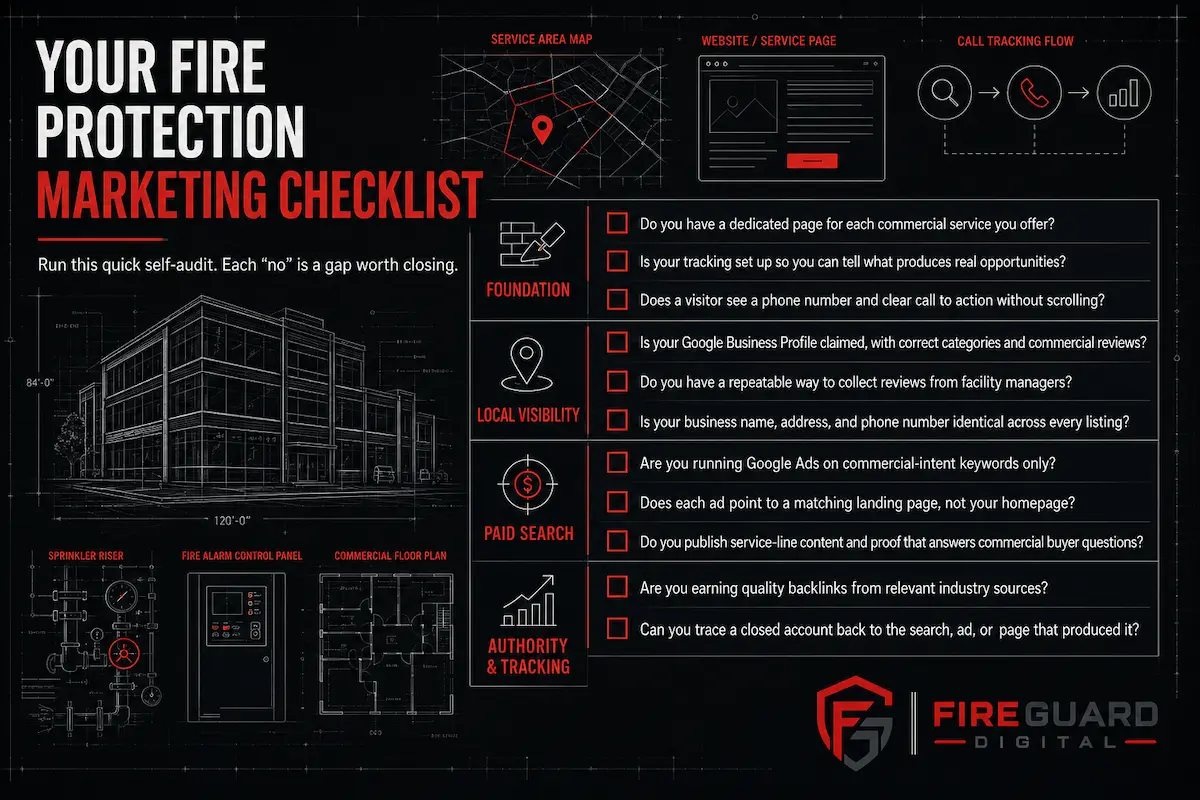
Run this quick self-audit on your own business today. Each “no” is a gap worth closing.
- Do you have a dedicated page for each commercial service you offer?
- Is your tracking set up so you can tell what produces real opportunities?
- Does a visitor see a phone number and clear call to action without scrolling?
- Is your Google Business Profile claimed, with correct categories and commercial reviews?
- Do you have a repeatable way to collect reviews from facility managers?
- Is your business name, address, and phone number identical across every listing?
- Are you running Google Ads on commercial-intent keywords only?
- Does each ad point to a matching landing page, not your homepage?
- Do you publish service-line content and proof that answers commercial buyer questions?
- Are you earning quality backlinks from relevant industry sources?
- Can you trace a closed account back to the search, ad, or page that produced it?
Want the printable version? Download the FireGuard fire protection marketing checklist and work through it with your team.
Fire Protection Search Marketing FAQs
Does SEO work for fire protection companies?
Yes. SEO works when it targets the commercial service searches facility managers use, such as “NFPA 25 inspection” or “commercial fire alarm inspection [city].” Generic homeowner-focused fire safety content usually does not produce the same type of opportunity.
How long does it take to rank a fire protection website on Google?
In many markets, a strong foundation can begin reaching page one in three to six months. Larger or more competitive cities can take longer. Google Ads can create visibility much faster while SEO builds.
How much should a fire protection company spend on marketing?
A serious blended SEO and Google Ads system in a mid-size market often runs in the low thousands per month. A better way to judge it is against the value of a commercial account. A few new accounts a year can return many times the spend.
Should I use Google Ads or SEO first?
Use both, in the right order. Build your search foundation first, so traffic converts. Then run Google Ads for fast, high-intent opportunities while your SEO builds. Ads deliver speed, SEO delivers durability, and together they cover the gap between launching and ranking.
How do I generate commercial fire protection leads?
Get found where facility managers search. Optimize your Google Business Profile, build a page for each commercial service, and target commercial-intent keywords with SEO and Google Ads. Collect reviews from commercial clients. Then track which channels produce qualified opportunities, and put more into what works.
Do fire protection companies need link building?
Yes, but quality over quantity. A few relevant backlinks from industry associations, suppliers, local business groups, or trade publications build real authority and lift your rankings. Cheap, mass-bought links do the opposite and can hurt you. Treat link building as earned trust, not a numbers game.
Are referrals enough to grow a fire protection company?
Referrals are valuable, but they are passive. They only capture demand you are already connected to. Search captures the demand you never knew existed. An owned search system gives you a second, steady source of commercial accounts, so growth does not depend entirely on who you know.
Where to Start
The opportunity to own commercial search in most fire protection markets is still open. But it will not stay open forever.
As larger, PE-backed groups expand city by city, the companies that build a strong search presence now will be much harder to compete with a year from today.
This playbook is how independent fire protection companies can win more commercial opportunities before that gap closes.
Start by understanding where you stand today.
Get a free fire protection marketing audit for your market. We will show you where your company appears in search, which competitors are showing up ahead of you, and the biggest opportunities to improve. No pitch. Just clear data.
Ready to build a search system that wins commercial accounts? Book your free strategy session.
We will look at your market, your services, and your biggest search opportunities, then map out how the FireGuard Search Stack could apply to your business.
No pressure. Just a clear plan.
FireGuard Digital | Search marketing built for fire protection. By someone who knows the industry from both sides.