The Complete SEO Guide for Fire Protection Companies
A sprinkler inspection came back with three problems. A hood suppression tag expired last month. A fire alarm is faulting and the usual contractor has not called back.
Someone near you is dealing with one of those right now.
So they Google (or ChatGPT) it.
They look for a company that does that exact job, in their area, that looks like it can handle a big building. Then they call whoever shows up first.
If you are not on that list, you do not lose a lead. You lose a job you never knew about.
This fire protection company SEO guide helps you fix that.
I have spent the last ten years running SEO and Google Ads. I’m also an active firefighter. I built FireGuard Digital to work with fire protection companies and nobody else.
Here is what you get in this guide. Seven steps, in order. A simple test for picking keywords. Straight answers on timeline and cost.
Read it start to finish or jump to the section that matters most right now.
No jargon, no fluff. Let’s go.
Table of Contents
What SEO Does for a Fire Protection Company
SEO means showing up on Google (and now AI Search) when a buyer searches for a job you do.
That is it.
Most owners think SEO is a race to rank for “fire protection company near me.” It is not.
The money is in smaller searches. Twenty to forty of them. Each one names a service and a place.
Watch the difference.
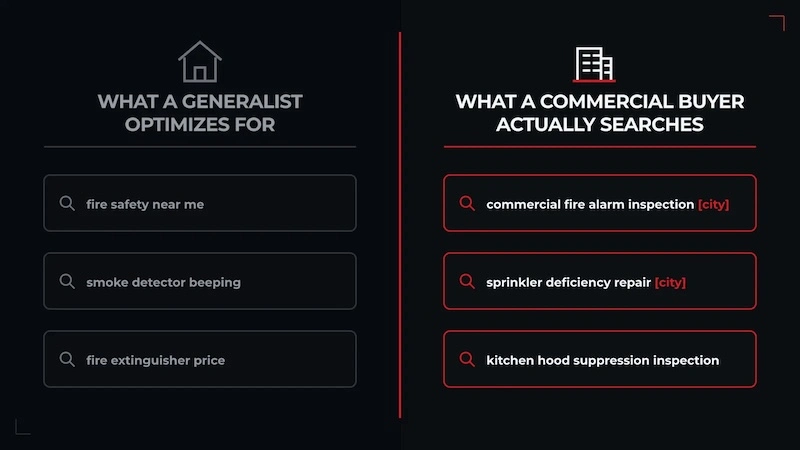
A facility manager does not search “fire safety services.” He searches “commercial fire alarm inspection [city].”
A property manager with a failed sprinkler report searches “fire sprinkler deficiency repair [city].”
A restaurant manager searches “kitchen hood suppression inspection [city].”
Three buyers. Three problems. Three pages.
SEO touches three things:
Your website. This is where a buyer decides if you do their kind of work.
Your Google Business Profile. This shows up in the map before your website does.
What other websites say about you. This is how Google (and AI) decides to trust you.
That is the whole game. Everything below is one of those three.
Want the bigger picture, with ads and reviews too? Read our complete fire protection marketing playbook. This guide goes deep on Search only.
Why Generic SEO Advice Fails in This Industry
Hired an agency and got nothing? The work was not the problem. The strategy and target was.
Three things go wrong.
They chase the wrong people. A general agency runs the same plan for plumbers and roofers. That plan chases traffic. In this trade, traffic means homeowners with a faulty smoke alarm or people pricing a single extinguisher. You receive those calls. None of them turn into accounts.
You have no pages to rank. This one is very common. You can post a blog every week for a year. But if your site has one Services page with fifteen jobs on it, Google has nothing to show for “commercial fire sprinkler inspection.” The blog was not the problem. Your page setup was.
The writing talks to the wrong reader. Fire safety tips. Fire Prevention Week posts. Ten ways to protect your home. Your buyers manage buildings. The law already makes them do this work. Nobody needs to sell them on fire safety.
Digital works. The plan was wrong.
Here is the good news. The door is still open.
The US fire protection industry is worth about $22.1 billion. Close to 20,000 contractors work in it. Almost none of them have built anything real in search.
This is not law or HVAC. Those markets have a dozen well funded competitors in every city. Yours may have none.
I broke down why most fire protection companies are invisible on Google in another article. The rest of this guide is the fix.
Where SEO Fits: The FireGuard Search Stack
Most agencies sell SEO, ads, websites, and Google profiles as four separate products.
Buyers do not shop that way.
A facility manager sees ads, map listings, reviews, your service page, three competitors, and an AI answer. All in thirty seconds. He is not thinking about channels. He is picking who looks credible and easy to call.
That is why scattered tactics make noise but not accounts.
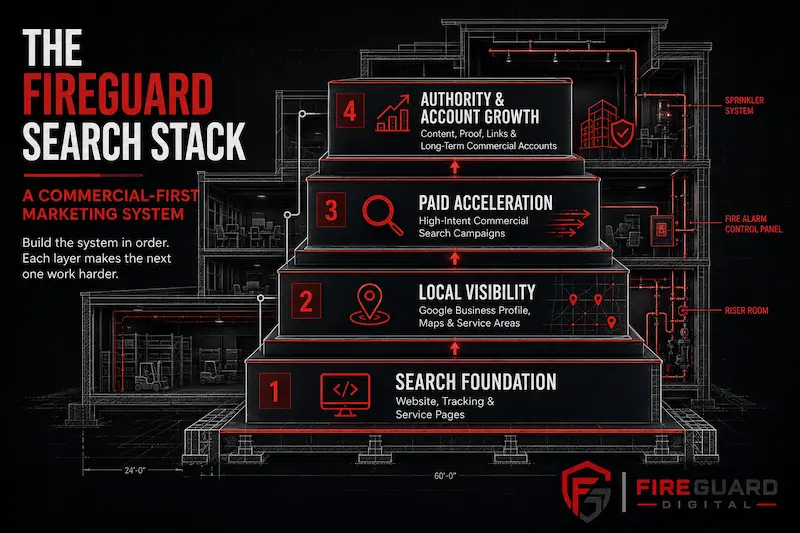
The FireGuard Search Stack: A Commercial-First Marketing System ties it together. It has four layers. You build them in order.
Layer 1: Search Foundation. Your website, service pages, and tracking. The base.
Layer 2: Local Visibility. Showing up in the cities/areas you serve.
Layer 3: Paid Acceleration. Google Ads. You buy speed while the rest grows.
Layer 4: Authority & Account Growth. Content, proof, and links. This makes you hard to replace.
Now here is the part that matters for this guide.
SEO is not one of the four layers. It runs through three of them.
Service pages are Layer 1. Getting found in your cities is Layer 2. Content and links are Layer 4. Paid Acceleration is a different job with a different budget, so this guide leaves ads alone.
Build in order and each layer makes the next one work harder.
Skip ahead and you burn money. Run ads with a weak site and you pay for clicks that don’t convert leads. Build pages with no tracking and you never learn which of it produced work.
You can see the full framework and all four layers on the FireGuard Search Stack.
The seven steps below build Layers 1, 2, and 4. Each step is tagged with its layer. That tag tells you what you get, and what breaks if you skip it.
The Commercial Intent Filter
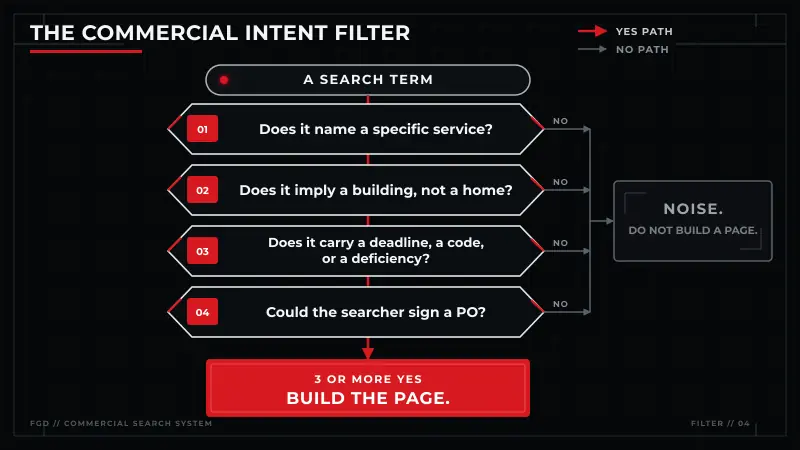
Everyone says “target high-intent keywords.”
Nobody tells you how to spot one.
Here is the test. It takes five seconds. You do not need a tool.
The Commercial Intent Filter
- Does it name a real service, not a category?
- Does it sound like a building, not a house?
- Does it come with a deadline, a code, or a problem to fix?
- Could the person typing it sign a check?
Three or more yes answers? Build a page.
Try it on “fire protection services.” It names a category. It could be a house. No deadline. Often typed by someone who cannot buy anything. Zero out of four.
That is the term everybody wants. It is also the term nobody closes.
Now try “fire sprinkler deficiency repair [city].” It names a service. It is a building. There is a problem and a clock. The person typing it has to get it fixed. Four out of four.
| Worth a page | Not worth a page |
|---|---|
| commercial fire alarm inspection [city] | how does a fire sprinkler work |
| fire sprinkler deficiency repair | smoke detector chirping |
| NFPA 25 inspection contractor | fire extinguisher price |
| kitchen hood suppression inspection [city] | fire safety tips for home |
| commercial fire pump testing | what does a red fire alarm mean |
| backflow prevention assembly test [city] | fire drill checklist |
| fire alarm monitoring commercial building | are sprinklers required in houses |
| annual fire extinguisher service contract | fire safety awareness month |
There is a bonus here. It answers a question I get all the time.
This is how you stop getting homeowner calls.
You do not rank for a page you never built. No page about smoke alarm batteries? Then you will not show up for smoke alarm batteries.
The filter picks your targets. It also blocks the junk.
How to Do SEO for a Fire Protection Company: The 7-Step Build Order
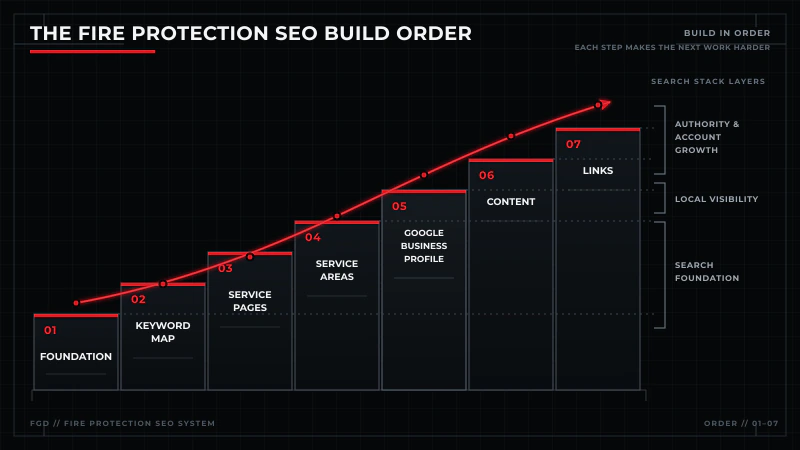
The FireGuard Search Stack is the larger system. This six-step playbook shows you how to put it The Search Stack is the system. This is the order you build it in.
The Fire Protection SEO Build Order
- Fix your website and tracking before you chase any ranking.
- Match every service you sell to the words buyers type.
- Build one page for each service, not one page for all of them.
- Build city pages that say something true about each city.
- Claim and fill out your Google Business Profile.
- Write answers to the questions buyers ask before they call.
- Earn links from sites Google already trusts.
The order is the point.
Skipping ahead is the top reason this fails. And you do not see it fail. You find out steps three and four were missing in month six. The traffic came. Nothing happened.
Step 1: Fix the Foundation First
Search Stack layer 1: Search Foundation
If your site is broken or outdated, more traffic just costs you more.
Start with what a buyers sees in the first four seconds. Your phone number and one clear button should show up without scrolling.
Picture your buyer. He is standing in a mechanical room, on his phone, with ninety seconds of patience.
The site has to load fast on that phone.
Use real photos. Your crew. Your trucks. Real jobs in real buildings. Not a stock photo of a sprinkler head. A facility manager spots the difference in one look.
Build your page structure for search before the design gets locked.
Most companies learn this backward. They pay a designer to make it pretty. They launch. The phone doesn’t ring. Then they pay someone else to rebuild (or optimize) the structure so the site turns visitors into calls. That is two bills for one website.
Google’s own guide explains what a page needs to rank. It takes ten minutes to read. If you are rebuilding anyway, get a fire protection website built for search from day one.
Then turn on tracking. Call tracking. Form tracking. A way to see which page made the phone ring.
Almost nobody does this. That is why almost nobody knows what works.
Here is a two-minute check you can run right now.
Open a private (incognito) browser window. Search your company name. Then search your main service plus your city.
Not at the top of page one for your own name? That is a real problem!
Nowhere for the service search? Then you are invisible to every buyer who does not already know you.
All of this is Layer 1, your search foundation. None of it is fun. All of it decides whether the next six steps do anything at all.
Want to see where you stand? Get a free fire protection marketing audit. No pitch. Just a clear look at what is working and what is not.
Step 2: Match Your Services to the Words Buyers Type
Search Stack layer 1: Search Foundation
Most fire protection websites name their services in words no buyer has ever typed.
“Life Safety Solutions.” “Inspection Services.” “Integrated Protection Programs.”
I see this all the time. Those words mean something inside your office. They mean nothing to a property manager with a problem.
Buyers type trade words. Real ones look like this:
- sprinkler ITM
- backflow test
- fire pump churn test
- kitchen hood suppression inspection
- fire alarm deficiency repair
- annual extinguisher service
ITM (inspection, testing, and maintenance) is how a lot of buyers describe the repeat work they shop for.
Buyers also type code numbers. “NFPA 25 inspection contractor” is a real search. So is “NFPA 72 fire alarm inspection.” They use the number because it is printed on the report in their hand.
As you know, NFPA publishes the codes this trade runs on. That includes NFPA 25 for water-based systems and NFPA 72 for fire alarms.
So make a two-column list.
Left side: every service you sell. Right side: the words a buyer would type.
Then add cities. Your real list is services times cities. Eight services across six cities is not fourteen terms. It is closer to fifty.
One more search moment belongs on your list. Almost nobody has a page for it.
A deficiency report is a search trigger.
An inspection finds problems. Those problems have to get fixed, and there is usually a clock on it. The company that did the inspection does not always get that call.
That buyer is the most motivated person in this whole industry. Your competitors ignore him.
Now run every term through the Commercial Intent Filter. Cut anything under three.
Every trade has its own version of this list. You can see them on Industries.
Step 3: Build One Page Per Service
Search Stack layer 1: Search Foundation
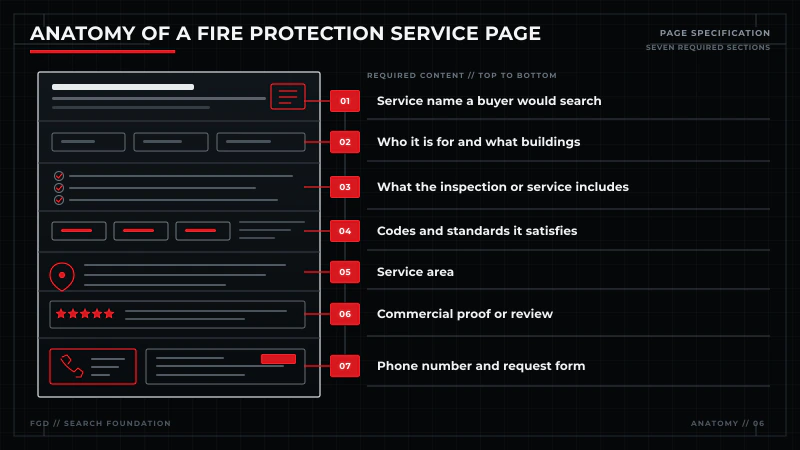
A buyer searching for fire alarm inspection should land on a page about fire alarm inspections.
Not a Services page with fifteen jobs and two sentences each.
This is the step people skip. It is slow. It is boring. It is also the one Google is waiting on.
Every service page needs seven things:
- The service, named the way a buyer types it. Not your internal name.
- Who it is for. Hospitals. Warehouses. Restaurants. Schools. Offices. High rises.
- What the work includes. What you check. What you test. What they get on paper.
- Which codes it relates to. NFPA 10 for extinguishers. NFPA 96 for commercial kitchens. And so on down your list.
- Your service area. The cities or areas you cover for that job.
- Proof from a commercial client. A review. A project. A building type.
- A phone number and a form. At the top and at the bottom.
So how many pages does a fire protection website need?
One per service. Plus one per city that matters to you.
For most independents that is eight to twenty-five pages. Not four.
Trades are not the same. A sprinkler contractor’s buyers do not search like an alarm contractor’s buyers. That is why fire sprinkler company marketing and fire alarm company marketing get built different from the ground up.
Build pages for the work you want more of. Best margin on deficiency repair? It gets a page. Chasing monitoring accounts? Same thing.
Step 4: Build City Pages That Are Not Fake
Search Stack layer 2: Local Visibility
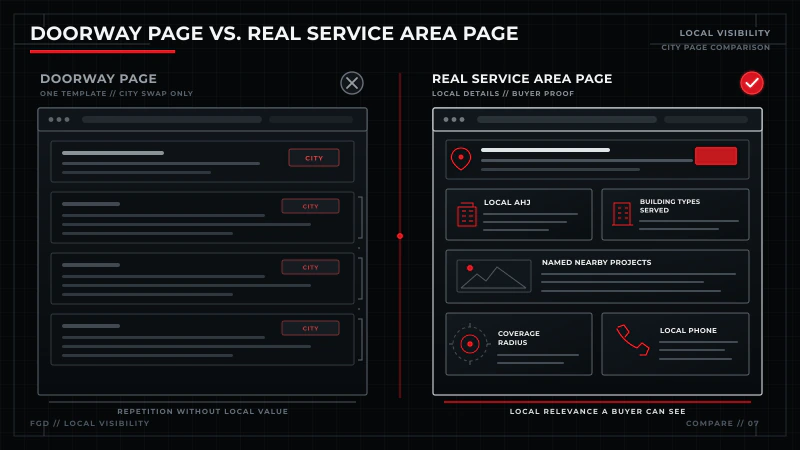
Yes, build a page for each city you serve.
No, it will not hurt you. But only if each page says something true about that city.
That condition is everything.
A fake city page is your home page with the city name swapped in. Google caught on to that years ago. Worse, so does the facility manager who lands on it and sees nothing about his building.
A real city page does five things:
- Names the kinds of buildings you serve there
- Names the local AHJ, the office that inspects and enforces in that area
- Says something about how that office works
- Names project types or landmarks nearby
- Uses a local phone number if you have one
Here is where a limitation turns into a competitive edge.
Every AHJ reads the code a little different. And the code edition in force in one city can be older than the one next door. That is the reality of working across markets.
It is also why a page written for one city is hard for a national competitor to fake.
NFPA offers free read-only access to the codes. That helps a building owner figure out what applies to him. It helps you write these pages too.
Quick note on “near me” searches, since owners ask about this a lot.
You do not target “near me.” You earn it. Google picks who to show based on distance, a complete profile, and location signals. So the work that wins those searches is Step 5 plus these pages. Not a phrase you sprinkle into your copy.
Three real city pages beat twelve thin ones. Build the markets you want to grow in.
City pages sit on your website. Your profile sits on Google. Same markets, two different places, and most markets need both. That whole side of the work is local search for fire protection.
Step 5: Fill Out Your Google Business Profile
Search Stack layer 2: Local Visibility
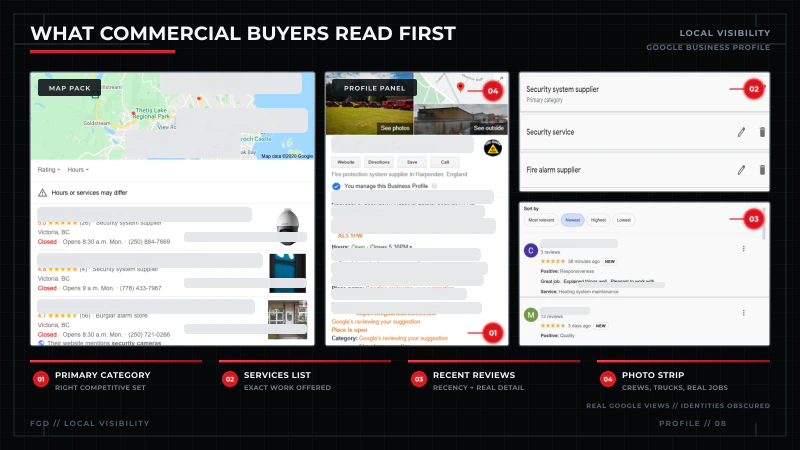
This is the fastest win you have. It is free. And most fire protection companies have not touched it.
Your Google Business Profile is the free listing with your name, phone, hours, photos, and reviews. It shows up in the map pack. That is the short list of businesses Google puts above the regular results.
For a lot of searches, that box is all a buyer looks at before he calls.
Four parts matter most:
Primary category. Get it right or you compete in the wrong group.
Services list. Fill it with the real service names from Step 2. Add a real description to each one. Most profiles leave this blank.
Recent reviews. Not just how many. How recent, and how detailed.
Photos. Your crew. Your trucks. Real jobs. Not a logo and a stock service truck photo.
Now the review strategy.
Most fire protection companies have mostly homeowner reviews. Homeowners leave them without being asked. Facility managers never do. It does not cross their mind, and nobody asks them.
So build a small review process. After a finished inspection or a completed repair, ask.
Five detailed reviews from property managers beat fifty from homeowners. They tell the next buyer you work in his world. They tell Google what kind of work you do.
Keep your name, address, and phone the same everywhere online. That is your NAP. Small differences between listings can hurt you.
Got more than one location? Each staffed office gets its own profile. Service areas do not. Google explains service area businesses here.
Steps 4 and 5 together are Layer 2, Local Visibility.
Everything above is the short version. Your profile has more than four fields, and the ones nobody fills out are usually the ones doing the least work. The complete GBP guide for fire protection walks through all seven steps, including which category to pick and the five mistakes that get profiles switched off.
Curious how you rank in the map today? See how your Google Business Profile is doing against the companies showing up above you.
Step 6: Answer the Questions Buyers Already Ask
Search Stack layer 4: Authority & Account Growth
“We should start a blog.”
That is where most fire protection content goes to die.
Content works. The wrong content does not.
Fire safety tips produce nothing. Your buyers run buildings that the law already forces to do this work. They are not the audience for a post about why fire safety matters.
What works is answering real questions from real facility managers.
Like these:
- Does my sprinkler system meet current rules, or was it grandfathered under an older code? (NFPA 13 covers sprinkler design, and what applies to an old building is rarely clear.)
- When is a clean agent system better than water?
- What do I do when the AHJ and my insurance company want different things?
- What happens if I miss an inspection deadline?
- Who pays for deficiency repairs, the tenant or the owner?
Every one of those is a real question.
Every answer makes you the company that understands the decision. Not just the installation.
Then there is the one nobody writes.
An inspection finds problems. Those problems become repair work, often at better margin than the inspection itself. And the person holding that report has a clock running.
He is searching right now. Almost nobody has a page for him.
If you write one thing this year, write that one.
This work also decides whether you show up in AI answers. About a third of B2B buyers now use AI tools to research vendors. Most of that research happens before they call anyone.
AI pulls from content that is clear, specific, and tied to a real business. Vague content gets skipped.
That is the whole idea behind showing up in AI search. And it is the same work that wins on Google.
Start with the question your team hears most on the phone. Want it built as a system instead of a side project? That is content built around buyer questions.
Step 7: Earn Links Google Trusts
Search Stack layer 4: Authority & Account Growth
A link is another website vouching for you. Google can read it. Get enough good ones and Google trusts you more.
For a fire protection company, the real sources are short and doable.
Trade groups come first. The American Fire Sprinkler Association and the National Fire Sprinkler Association both run member and chapter programs. Similar groups exist in alarm and suppression.
Then look at these:
- Makers and suppliers whose gear you service. Many list approved contractors.
- Local chambers and business groups.
- General contractors and property managers you already work with. Many have vendor pages.
- Trade magazines. They quote contractors who have something real to say.
Local links count too.
A link from a local business beats a link from a big site in another country. Google uses local links to work out where you really operate.
You already have these relationships. You just never asked.
Start with the list you have:
- Your chamber of commerce. Most give members a listing page with a link.
- The general contractors and property managers you work for. Many have a vendor page.
- Your suppliers and distributors. Ask if they list contractors by area.
- Local events you sponsor. A youth team, a food drive, a charity run. Sponsor pages link out.
- Trade schools and apprenticeship programs near you.
Send one email a week. Ask if they list partners on their site. That is the whole play.
These links do two jobs. They help your website rank. They also feed the location signals behind your map results from Step 5.
Now the warning. It matters more than the list.
Bought low quality links hurt you. Someone will email you offering 200 links for $200. That is not a shortcut. It is a mess, and cleaning it up costs more than the links did.
Treat links as earned trust. A few real mentions beat hundreds of junk listings.
This layer compounds. A service page, a real review, and an industry mention keep working for years. An ad stops the day the card declines.
That is why Authority and Account Growth sits at the top of the stack. You build it last, not first.
How to Tell If Your SEO Is Working
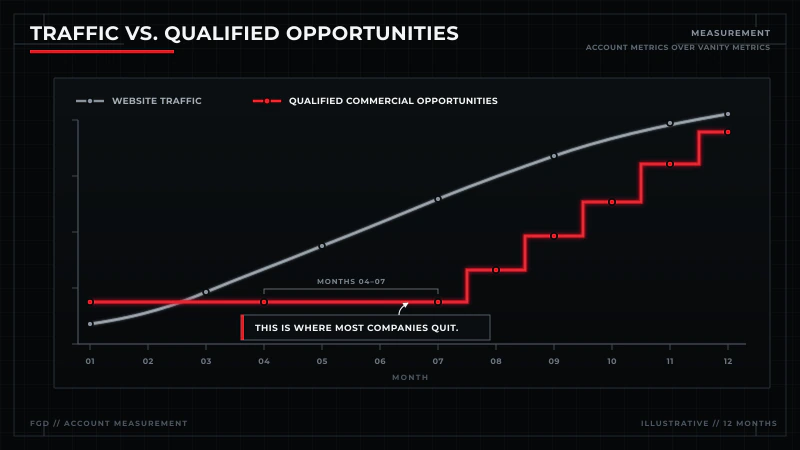
Most owners get shown traffic and rankings.
Neither one pays the bills.
Here is what to track instead.
Track every call and form back to the page that made it. Without this, everything else is a guess.
Ask whoever answers the phone which calls were real. Which were commercial. Which were homeowners. Which were junk. Fifty calls a month means little if forty are residential or spam.
Trace closed jobs back to the source. When a deal signs, find out what brought it in six weeks earlier. This is the step that changes your budget.
Then watch one number above the rest.
What does it cost you to win one commercial account, against what that account is worth?
One commercial inspection account is worth about $4,500 to $7,500 a year. That covers the inspection plus the repairs and service that follow.
Most of them renew. Switching vendors is a pain for a facility manager who already has a company that knows the building.
Over five years, five to ten of those accounts is $112,000 to $375,000.
* These numbers come from pricing listed publicly across many regions. Your numbers will change based on your area and the services you sell.
Once you can see that number, the rest of your decisions get easy.
One more thing. This saves campaigns that are working.
Traffic moves first. Accounts move later. Month four looks flat on every dashboard, even when the SEO work is going right. The pages are live. The buying cycles have not turned over yet.
That flat stretch is where most companies quit. About eight weeks before it starts paying off.
If you want this built properly rather than guessing, that is what setting up tracking properly covers.
How Long Fire Protection SEO Takes
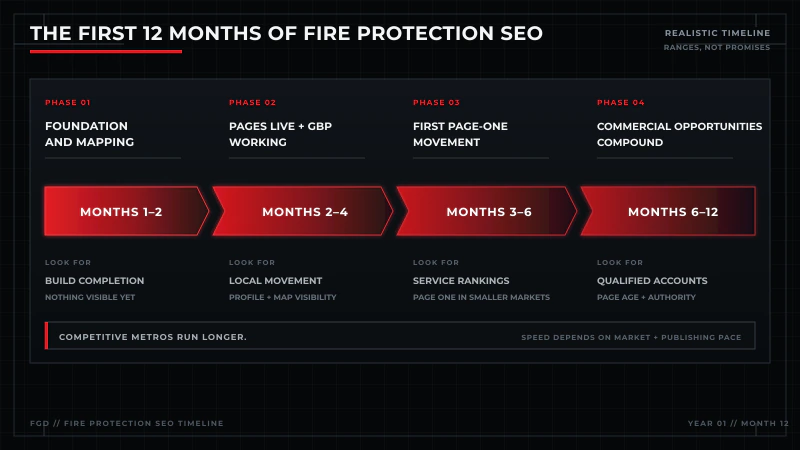
In most smaller markets, a solid build shows page-one results on service searches in three to six months. Accounts follow after that. Big competitive cities take longer. Google Business Profile work can move in weeks, which is why you do it first.
Here is how year one usually goes.
Months 1 to 2. Foundation and mapping. Nothing shows yet, because nothing is live yet.
Months 2 to 4. Pages go live. Your profile starts working. First movement in local results.
Months 3 to 6. Page one on service and city searches in most smaller markets.
Months 6 to 12. Accounts stack up as pages age and authority builds.
Four things move that timeline:
- How complete your website is today.
- How many services and cities you cover.
- How competitive your city is.
- How fast pages get written and published.
That last one is the real hold-up most of the time.
One limit worth knowing. SEO does not bring in accounts in 30 days. Google needs weeks to index changes and new pages. Then you wait for a buyer to search, and in this trade that runs on inspection dates. Most buildings come up once a year. Your job is to be there when one does.
What It Costs, and When to Hire Help
The useful question is not “what does SEO cost.”
It is “what is one commercial account worth to me over five years?”
A full program covering all seven steps in a mid-size market runs in the low thousands per month. A smaller scope costs less. Either way, judge it against the account math above.
A note on pricing.
Cheap SEO is not a smaller version of good SEO. It is a different thing. Old tactics. Thin pages. Spam links. Corners cut where you will not see them for six months.
There is a reason for that. A $500 retainer is not priced around the work. It is priced around volume. Sign a lot of companies, keep them a few months, move on.
You already know that business. It is the opposite of yours.
You hold an inspection account for years because you know the building and do good work. Good SEO works the same way. Look for a partner who plans to still be with you in year three, not the one trying to make quick cash.
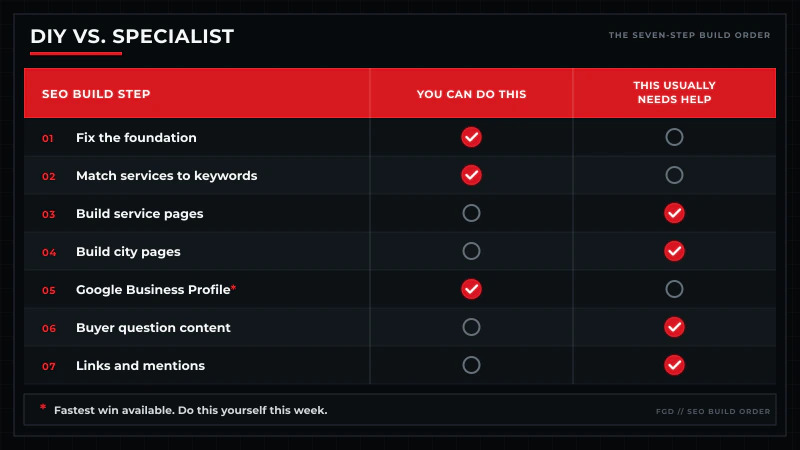
Now the practical question. Which steps can you do yourself?
| Step | You can do this | Needs help |
|---|---|---|
| 1. Fix the foundation | Part of it | Yes, if you are rebuilding |
| 2. Match services to keywords | Yes | No |
| 3. Build service pages | No | Yes |
| 4. Build city pages | No | Yes |
| 5. Google Business Profile | Yes | No |
| 6. Buyer question content | Part of it | Yes |
| 7. Links and mentions | No | Yes |
* Step 5 is your fastest win. Do it yourself this week, no matter what you decide about the rest.
Steps 2 and 5 are doable in-house. You know your services and your buyers better than any agency will in month one. And nobody needs a specialist to fill out a Google profile.
Steps 3, 4, 6, and 7 are where most companies stall. Not because they are hard to understand. Because they are volume work with a technical floor. Twenty pages built to one standard is a project, not a weekend.
Now let’s be clear about fit.
This approach is not built for a mostly residential shop.
If your business is young or thin on cash, spend the money somewhere else first.
If you need work booked next month, this is not the lever. That is what ads are for.
This works best for established commercial companies. Ones ready to build over time. Ones that can handle the accounts when they land.
One more fit worth naming.
Planning to sell in the next five years? Then this work counts twice.
Every recurring inspection account is cash now. It is also revenue a buyer pays a multiple on later. Advisory firms that handle these deals put annual inspection agreements in the two to three and a half times range.
Ten new accounts at $4,500 to $7,500 each is $45,000 to $75,000 in new recurring revenue. Using their ranges, that same revenue is worth another $90,000 to $262,500 at the table.
That is what The FireGuard Exit-Ready Revenue Program is built around. Same work. Different scoreboard.
* Note: we are not brokers or valuation experts. Those ranges come from firms that are. Hire one when you get close.
Got this far and counted four steps you are not going to do yourself?
Good. That is useful to know.
No pitch. Just a clear look at where you stand today, who shows up above you, and the biggest gaps.
Your Fire Protection SEO Checklist
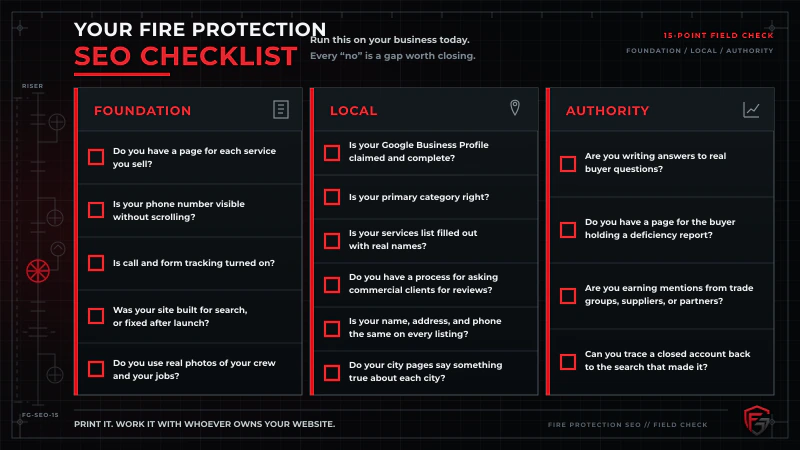
Run this on your business today. Every “no” is a gap.
Foundation
- Do you have a page for each service you sell?
- Is your phone number visible without scrolling?
- Is call and form tracking turned on?
- Was your site built for search, or fixed after launch?
- Do you use real photos of your crew and your jobs?
Local
- Is your Google Business Profile claimed and complete?
- Is your primary category right?
- Is your services list filled out with real names?
- Do you have a process for asking commercial clients for reviews?
- Is your name, address, and phone the same on every listing?
- Do your city pages say something true about each city?
Authority
- Are you writing answers to real buyer questions?
- Do you have a page for the buyer holding a deficiency report?
- Are you earning mentions from trade groups, suppliers, or partners?
- Can you trace a closed account back to the search that made it?
Download the fire protection SEO checklist and work it with whoever runs your website.
Fire Protection SEO FAQs
What is the difference between SEO and local SEO for a fire protection company?
SEO covers everything that helps your website rank. Pages, content, structure, links. Local SEO is the part that gets you found in one area. That means your Google Business Profile, the map pack, city pages, and reviews. For a fire protection company they overlap a lot, because almost every good search has a city in it. Local SEO moves faster. You need both.
How long does fire protection SEO take to bring in commercial accounts?
Page one on service searches usually takes three to six months in smaller markets. Longer in big cities. Accounts come after that. This trade runs on inspection dates and deadlines, not impulse buys. Most companies see real account activity between month six and month twelve. Google Business Profile changes can show up in weeks.
How much should a fire protection company budget for SEO?
A full program in a mid-size market runs in the low thousands per month. A smaller scope costs less. Size it against one account, which is worth about $4,500 to $7,500 a year and usually renews. Three to five new accounts in a year covers a serious SEO campaign several times over.
What keywords should a fire protection company target?
Target searches that name a real service, sound like a building, come with a deadline or a code, and get typed by someone who can sign a check. That means terms like “commercial fire alarm inspection [city],” “fire sprinkler deficiency repair,” “NFPA 25 inspection contractor,” and “kitchen hood suppression inspection.” Skip anything that sounds like a homeowner question.
How many pages should a fire protection website have?
One page per service. Plus one page per city that matters to you. For most independents that is eight to twenty-five pages, not four. A full-service company covering alarm, sprinkler, extinguisher, suppression, pump, and backflow across a few cities lands at the high end. One generic Services page is the top reason these sites do not rank.
Should I build a page for every city I serve?
Yes, if each page says something true about that city. Name the buildings you serve there. Name the local AHJ. Mention nearby project types. Use a local phone number if you have one. A page that is your home page with the city swapped in will not help you. Three real pages beat twelve thin ones.
Will a blog bring in commercial inspection work?
Fire safety tips will not. Your buyers already know fire protection matters. They run buildings that require it. What works is answering the questions facility managers ask. Does an old system still meet code? Who pays for repairs? Clean agent or water? Write for the person holding a deficiency report. Not for a homeowner.
Can I do fire protection SEO myself?
Some of it. Matching your services to real search terms is doable. So is filling out your Google Business Profile, which is your fastest win. Building fifteen to twenty-five pages to one standard, writing buyer content, and earning trade links is volume work. Most owners run out of hours before they run out of will.
Where to Start
Order beats tactics. Foundation. Then local. Then authority. Skip ahead and the base falls out from under you.
Commercial search is still wide open in most fire protection markets. That will not last. PE-backed groups are buying independents city by city. They spend on digital the day they close. The companies that build now will be hard to catch a year from today.
Start by finding out where you stand. Get a free fire protection marketing audit for your market. We will show you where you show up, who is ahead of you, and the biggest gaps. No pitch. Just data.
Want to see how we build SEO campaigns as a done-for-you program? That is there too.
Already know you want a plan? Book your free strategy session. We will look at your market, your services, and your best openings. Then we map how the FireGuard Search Stack fits your business. No pressure. Just a plan.
FireGuard Digital | Search marketing built for fire protection. By someone who knows the industry from both sides.