
Four Moves That Turn Ontario’s Fire Code Change Into New Accounts
Since January, your buyers have been getting inspection quotes that do not look like last year’s.
A property manager sees a number he did not budget for. He takes it to his condo board. The board asks him why it went up. He does not have a good answer, so he goes looking for one.
None of them called you to ask.
They searched.
You already know why the price moved. Ontario changed the rules for fire alarm inspections on January 1, and you have spent the year adjusting to it. New forms. Retrained techs. Longer days on site.
Your buyers never got that memo.
So they are asking questions your website does not answer, which means they end up on a website that does. Usually it belongs to another fire protection company. Sometimes it is even a software vendor who wrote a blog post about it in February.
Either way, that company now looks like the one who knows what is going on.
I have spent the last ten years in SEO and Google Ads. I am also an active firefighter. I know the fire industry from both sides.
This is the marketing playbook for the Ontario Fire Code change, and almost nobody in your market is running it. Four moves, in order, with copy you can use.
The first one you could finish this afternoon.
Table of Contents
What Actually Changed in 2026
You know this part. Here it is in three lines anyway, because the rest of the article leans on it.
Ontario updated the Fire Code (O. Reg. 213/07) through O. Reg. 87/25. Since January 1, 2026, annual fire alarm inspections in Ontario follow CAN/ULC-S536-2019.
Your techs adapted within a week.
Most of your buyers have no idea.
What This Did to Your Buyers
A code change does not move buyers.
An invoice does.
For most buildings, the first annual inspection under the new edition is the moment the owner finds out anything happened. He looks at the number. Then he looks it up.
Some companies got in front of it. They sent a letter in November explaining what was coming and why the price would move. Those companies took a handful of calls in January instead of forty, and they came off as the ones who had it handled.
If you did not send that letter, you are not late. Every building that has not had its annual inspection yet has not had this conversation yet either.
Different roles are doing the searching, and they are not asking the same question.
A property manager wants to know what he is responsible for now.
A condo board wants to know why the invoice went up, and whether the increase is real.
A facilities director wants to know what paperwork he has to keep, and for how long.
An owner with a single building just wants to know whether he has to spend money.
Not one of those is a question about fire alarms.
They are questions about money, liability, and paperwork. And they come from the people who sign your contracts.
This is also not a January story. Every building hits its first inspection under the new edition on its own anniversary date, and plenty of them have not hit it yet.
The searching runs all year.
Your buyers never stopped asking the old questions either. Those still get typed far more often than anything in the right column below.
What changed is who is answering.
| What they have always asked | What they are also asking now |
|---|---|
| Who does fire alarm inspections near me | Why did my fire alarm inspection cost go up |
| Fire alarm inspection cost | Do I have to replace my fire alarm system |
| Commercial fire alarm company | What records do I have to keep, and for how long |
| Fire alarm inspection company reviews | What should my inspection report include |
Most fire protection companies do not have a page for either column.
Walk through ten fire protection websites in your province. Most have one Services page with a bullet list on it. Almost nothing built to answer a specific question.
This industry is years behind on that. One good page moves the needle here in a way it would not in another trade.
So both columns are open. The right column is the easier one to take, because those questions are new and almost nothing exists yet.
Somebody in Your Market Already Answered Them
Do not take my word for it. Go look.
Open a private window. Search the change the way a property manager would, not the way a contractor would. Put your city in it.
You will get a mix. Fire alarm software vendors. A training company or two. And usually a few Ontario fire protection contractors who published a page in the first weeks of the year.
Those last ones are your competitors.
It is not crowded, though. Most Ontario contractors published nothing at all, which is exactly why this is still worth doing.
And the ones who did publish are not getting much traffic. Traffic was never the prize.
They get the call from a property manager who found an answer and a company name in the same place.
That search shows you who is ranking. It does not show you why.
That is what the free Fire Protection Marketing Audit is for, and it covers a lot more ground than this code change. We grade seven parts of your search presence. Your Google Business Profile and map pack position. Organic search. Google Ads. Your website and whether it converts. AI search. Your reviews. Your tracking.
Then we benchmark you against a competitor in your market and put a dollar range on what the gap is worth.
You get a short report back. No pitch attached.
The Code Change Play
Almost everybody who reacts to a code change does one thing. They write a news post about the regulation. Then they wait.
A post can work. On its own, it is the slowest option you have. It needs to get indexed, then it needs to outrank whoever published back in January. And while it waits, your service page and your Google listing still read exactly like they did last year.
Those are the two places your buyers actually look.
A change like this opens more than one door.
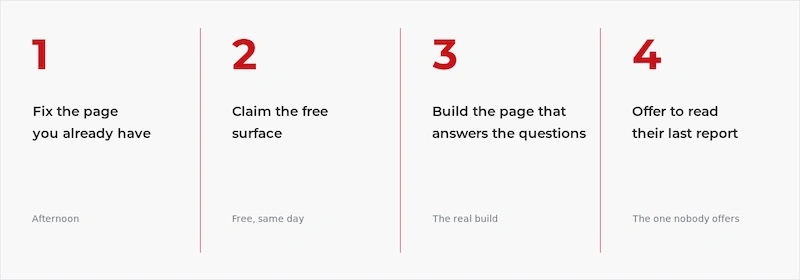
There are four. They build on each other, and the order matters, because the fastest return sits in the one nobody bothers with.
- Fix the page you already have.
- Claim the free surface.
- Build the page that answers the questions.
- Offer to read their last report.
Most companies do number three and stop.
Number three is the slowest one on the list.
Move one you could finish this afternoon.
Move 1: Fix the Page You Already Have
Somebody in your city is searching for a commercial fire alarm inspection today.
That demand is not new. The code change did not create it. But right now it is being decided between you (hopefully) and two other companies.
Here is what those three pages look like. Two of them say what every fire protection website says. Certified technicians. Fully licensed and insured. Serving the region since whenever.
The third one names the code edition it inspects to and tells the owner what he actually gets.
Before. This is on most Ontario fire alarm pages right now.
“We provide annual fire alarm inspection and testing for commercial buildings across the region. Our certified technicians are fully licensed and insured.”
After.
“We inspect and test to CAN/ULC-S536-2019, the edition Ontario adopted on January 1, 2026. When we are done you get a report showing what was tested, what passed, and what needs attention, written in plain language you can pass straight to an owner, a board, or head office. And if your system met the requirements before the change and still meets them, it is grandfathered. Nothing is getting ripped out.“
Ask yourself which one a property manager trusts.
He cannot judge your technical work. He has no way to tell a thorough inspection from a rushed one. So he judges what he can see, and what he can see is whether you sound like a company that knows what changed this year.
Now write it in your own words.
Do not paste that example exactly as it’s written. Your company has a voice. Your delivery is not the same as anybody else’s.
If you send reports through a portal, say that.
If your techs walk the building with the superintendent before they leave, say that.
If you turn reports around in three days, say that.
The wording has to be true, or the first phone call goes sideways.
And use the words your buyer uses. He is a property manager, not a technician. He does not know what a field device is. He knows what a report is, and he knows what a surprise invoice feels like.
That is the move. If you do not have that service page at all, skip to the note at the end of this section.
Then take it one step past what your competitors will do.
Put an example inspection report on the page. Do not publish a real one from a real building. Build a sample in your own report format, using made up building details, so nothing on that page belongs to a customer.
Most property managers have never seen a full inspection report until they get billed for one. A sample answers the question he is actually asking, which is what am I getting for this money. Being the company that shows him first beats another paragraph about your certifications.
Here is why this move is the fastest one on the list. You are not asking Google for anything new. The page already exists and it already ranks for something. You are making it say the thing your buyer is worried about right now.
Note: this assumes you have a fire alarm inspection page. Plenty of companies do not, or they have one Services page with a bullet list on it.
If that is you, this is a bigger job, because you are building the foundation before you can improve it.
That is Layer 1 of the FireGuard Search Stack, and it is worth doing whether the code changed or not.
There is more on page structure in our fire protection SEO guide. For how this plays out at alarm shops specifically, see fire alarm company marketing.
Move 2: Claim the Free Surface
This one costs nothing.
Your Google Business Profile is where a lot of these searches end up. A property manager worried about a bill often never leaves the results page. He gets the info from there then calls.
So make your profile say what your website now says. Get the answer in front of him before he clicks anything.
Three things to update. You can do all three today.
Add the service, with a real description
Most profiles have a services list that reads “Fire Alarm Inspection” and stops.
That is a label. A description is a sales asset, and it shows up while somebody is deciding.
Service name: Fire Alarm Inspection and Testing (CAN/ULC-S536-2019)
Service description (245 characters): “Annual fire alarm inspection and testing for commercial and multi-residential buildings, to CAN/ULC-S536-2019. You get a written report showing what was tested, what passed, and what needs attention. If your system is grandfathered, we tell you.”
Google caps service descriptions at 300 characters, so this one fits with room to spare. Yours needs to fit too.
Write your own version. Change it to match how your company talks and how you actually deliver. If you serve one building type more than the others, name it.
Post about the change
GBP posts show up on your profile for people who are already looking at you. It takes a few minutes, and it puts the change in front of somebody who is deciding between you and two other companies right now.
Ontario’s Fire Code changed on January 1, 2026.
Fire alarm inspections in Ontario now follow CAN/ULC-S536-2019. If you own or manage a building, your next annual inspection will look different, and so will your report.
Your installed system is grandfathered. The inspection is what changed.
Questions about your building? Call us.
Same instruction. Rewrite it in your voice before you post it.
Feed the AI
This part changed recently and a lot of the advice online has not caught up.
Google retired the old Q&A section on Business Profiles. Maps now answers questions with AI instead, through an ask button on the listing. It pulls from your profile, your reviews, your photos, and your website.
So you cannot seed the answer anymore.
You publish it, and the AI goes and finds it.
That changes what matters. What Google tells a property manager about your company now depends on what you have written down, and where.
If the answer doesn’t exist anywhere, the AI has nothing of yours to work with. It will still answer him.
There is more on the profile itself in our fire protection Google Business Profile guide, and on how this layer works in our Search Stack local visibility.
Move 3: Build the Page That Answers the Questions
Now the new page.
Most people get this wrong in the first ten seconds. They title it “Ontario Fire Code Update” and summarize the regulation.
That is a press release. Nobody searches for a press release.
Write the page for the question, not for the event.
What follows is the whole build. Hand it to whoever runs your website. It is not complicated. It is just specific.
What to call it
| What most contractors publish | Publish this instead | |
|---|---|---|
| Page title | Ontario Fire Code Changes 2026 | What Ontario’s 2026 Fire Code Change Means for Your Building |
| Page URL | /blog/2026/01/ontario-fire-code-update/ | /ontario-fire-code-changes-fire-alarm-inspections/ |
Two rules under that.
The title belongs to the buyer, not to the code. “Your building” is doing all the work in that second version. One says a thing happened. The other says a thing happened to you.
Keep the year out of the web address. Put 2026 in the address and the page looks stale next January. Your only options then are a redirect, or a rename that throws away whatever the page earned. The year goes in the page title, where changing it is a small edit.
Same goes for date-based web addresses generally. A lot of contractor sites still run them because it is a default nobody turned off. Turn it off.
What to target
You need one main term and a list of questions.
The main term is the one people actually type: ontario fire code changes 2026.
But you do not build the page around the term. You build it around the questions, and the questions become your subheadings.
- Why did my fire alarm inspection cost go up
- Do I have to replace my fire alarm system
- What records do I have to keep, and for how long
- What should my inspection report include
- Who is allowed to do the inspection
Notice something about that list.
Those are the questions. You have the answers.
That split is the whole reason this works. It is also why no marketing company can write this page without sitting down with you first. The questions are marketing. The answers are your trade.
Two more terms worth grabbing while nobody is looking. The standard designation, and the regulation number. Almost nobody searches them. Grab them anyway. A property manager who types a regulation number into Google is not browsing, and there is nobody competing for plain language pages about it.
Then two rules that keep you out of trouble.
Keep your city off this page. No “Toronto fire alarm inspection” in the heading, the page title, or the body copy. Your service page is the one that targets your city, and it should stay the only one that does. If both pages chase the same city term, Google has to choose between them, and you have made your own two pages compete. This page targets the question. Your service page targets the city.
Do not build a version for every city. One page for Ontario. Copy it ten times with the city name swapped and you get ten weak pages fighting each other. One strong page beats all ten. There is more on this in our fire protection SEO guide.
What the page has to say
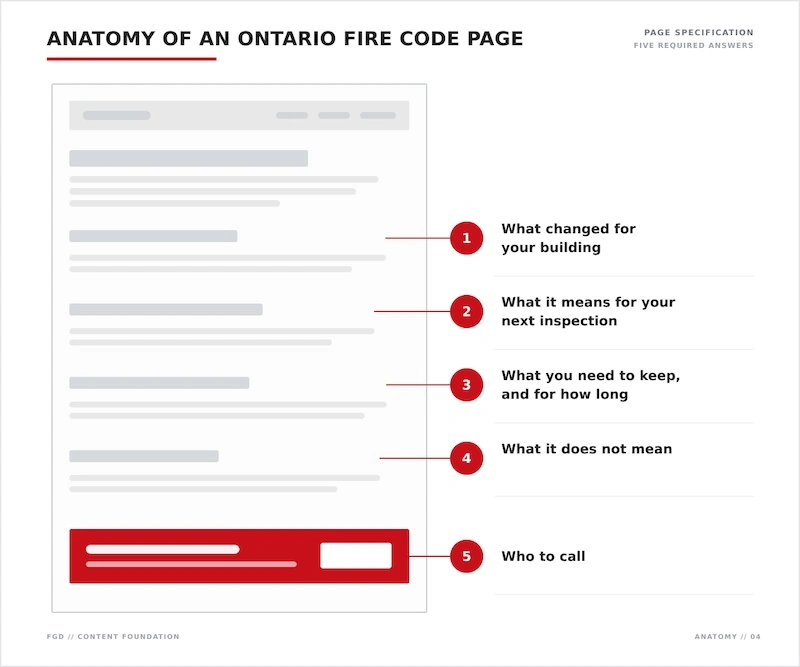
Five things. Each one tied to a question a buyer actually asks.
- What changed for your building
- What it means for your next inspection
- What documentation you need to keep, and for how long
- What it does not mean
- Who to call
Number four is the one worth spending time on.
The Fire Code grandfathers equipment and systems that met the requirements before the change and still meet them. The installed system is grandfathered. The inspection is what changed. Nobody is ripping anything out.
Almost nobody publishes that.
Think about what happens when a building owner reads it. He has spent two weeks assuming a capital expense he did not budget for is coming. Then a company he has never dealt with tells him he is fine.
He remembers who told him.
One thing to avoid while you write it. S536 is a copyrighted document. Buying a copy licenses your company to use it, not to republish it, and that license specifically rules out copying the material into other documents. So keep its forms, its tables, and its exact wording off your website.
Describe what the owner receives in your own words instead. It reads better anyway. Nobody outside the trade wants to read a standard.
Whatever you end up building, link to it from your fire alarm inspection page, and link back the other way. A page nothing points to is a page nobody finds.
Move 4: Offer to Read Their Last Report
This is the one nobody in your market is doing, and it is the reason the other three convert.
Every page like this ends the same way. Contact us for a quote.
Think about who is reading it. He is not shopping. He is worried. He got a bill he did not expect and he is not certain his paperwork is right. Asking a worried man to buy is how you lose him.
So ask him for something else.
Send us your last inspection report. We will review it against the current standard and tell you where it stands.
Read that again, because it does three jobs at once.
It answers the exact thing he is anxious about, which was never really the price.
It costs him nothing and commits him to nothing, so there is no reason to say no.
And it puts a full inspection report from a building you do not service on your desk. That is competitive research your competitors would pay for, and a building owner just handed it over for free. You get to see what the other company delivers, how thorough it is, and where the gaps are. All before you quote a dollar.
The offer, as it should appear on the page.
Not sure your last inspection report holds up?
Send it over. We will review it against CAN/ULC-S536-2019 and tell you where it stands, including if everything is in order. No charge and no obligation.
This is a review of your paperwork, not an official ruling. Your local fire department or fire inspector (AHJ) has the final say on compliance.
[ Send my report ]
Where you put this matters as much as the wording.
Not just at the bottom of the page. Put it right after the reassurance, in the part where you told him his system is grandfathered.
That is the moment he trusts the page.
This is not just a clever tactic. It is how accounts change hands.
Note: only offer this if you will actually do it. A free offer nobody answers is worse than no offer at all. It is also the kind of thing property managers mention to each other.
Legal caution: keep this a review of paperwork, not a ruling on compliance. Tell the owner what you would expect to see in a report like his. Do not tell him he is compliant, and do not speak for the fire inspector. Put that in plain language on the page.
We are a marketing agency, not a law firm. Before this goes live, have your own lawyer or your insurance broker read the wording. Any time you put a free written opinion in front of a building owner, cover yourself properly first.
Three Ways to Get This Wrong
A building owner is never going to understand the Fire Code, and he doesn’t want to. He is not going to read it. What he wants is confidence that the company inspecting his building knows it cold and will hand him everything he needs to stay compliant.
That is what your page is really selling.
Which is why one wrong detail costs more than it looks like it should. Somebody who reads three contractor pages that contradict each other does not come away understanding the code. He comes away deciding which two companies to distrust.
Do not tell buildings they are non-compliant. The Code grandfathers systems that already met the requirements. Some Ontario pages published the opposite in January. If a property manager checks, and some of them will, everything else on your page goes with it.
Do not repeat numbers you cannot source. There are labour and cost percentages circulating about what the new edition adds to an inspection. They trace back to vendor estimates rather than anything published. Put a number on your page you cannot back up, and a skeptical reader now has a reason to check every other claim you made.
Do not paste the standard. It is a copyrighted document. Write what the owner receives in your own words.
Accuracy is not a compliance issue here.
It is a conversion issue.
This Will Happen Again
Codes move on a cycle. Ontario just showed how far behind a jurisdiction can get before it catches up.
The next change will do what this one did. Buyers will search. The company with a page already up gets found while everybody else is deciding whether to write one.
So do not think of this as the Fire Code play.
Think of it as what you run every time your buyers get a new question. Four moves, same order, different trigger.
And you do not need a regulation to start one. The triggers are already sitting there, all year, and nobody serves them.
The deficiency report is the clearest one. A building owner gets a report full of deficiencies. He has a clock running and a number he was not expecting. So he searches.
Almost nobody has a page for that either.
That is local search doing what it is supposed to do. Get found when your buyer has a question, and be the company that answers it.
Ontario Fire Code Marketing FAQs
My competitor already published a page about this. Is it too late?
No. One page in a category this empty is not a lead you cannot close. And three of the four moves do not touch his page at all. Move 1 improves a page you already own. Move 2 happens on your own Google listing. Move 4 is not something he is offering. You are not racing him for one keyword, you are covering ground he left open.
How long before any of this shows up in search?
Move 1 usually turns over fastest, because Google already knows that page and is only re-reading it. Move 2 can appear within days, since it is your own profile. A brand new page takes longest, because it has to get indexed and then earn its position against pages that have been up since January. Nobody can give you a firm date on any of it, and anyone who does is guessing.
Should I write this myself or hire someone?
Write the answers yourself, or at least talk them through with whoever does the writing. The questions are marketing. The answers are your trade. A writer who has never read an inspection report will produce something that sounds fine and says nothing. A property manager can tell inside two sentences.
Do I need a separate page for every city I serve?
No. One page for the province. Your service pages carry the cities and they should stay the only pages that do. Copy the same page with the city name swapped and you end up with several weak pages competing against each other. One strong page outranks all of them.
What if my marketing company never brought this up?
That is a fair question to put to them. A rule change in your province moved what your buyers search for. An agency working in fire protection should have raised that in January. If the answer is that they did not know about it, you have learned something about how closely they follow your industry.
Is this worth doing if most of my work comes from referrals?
Yes, and probably more than you would expect. Referrals still look you up before they call. Those conversations often start with somebody asking why their inspection cost went up. Be the company with the clearest answer and the referral turns into a signed contract instead of a price comparison.
Where to Start
Your buyers changed. Your website did not.
You do not need all four moves this week. You need one.
Go open your fire alarm inspection page and read it the way a property manager would. Not the way a contractor would. If it does not name the edition you inspect to, and it does not say what he actually gets, fix that today.
That is Move 1. It is free and it is the fastest thing on the list.
The window here is unusually open. Ontario is a small market. Almost nobody has published anything. And the searches keep coming as buildings hit their inspection dates through the rest of the year.
Want to see what comes back when your buyers search in your city?
Ready to build it instead of reading about it? Book a free strategy session and we will map it to your market.
FireGuard Digital | Search marketing built for fire protection. By someone who knows the industry from both sides.